
Pitso Won It From the Bench: What Bafana’s 2–1 Win Over Guinea Really Told Us
 South Africa
 Guinea
Pitso Mosimane’s return to Bafana Bafana began with three points.
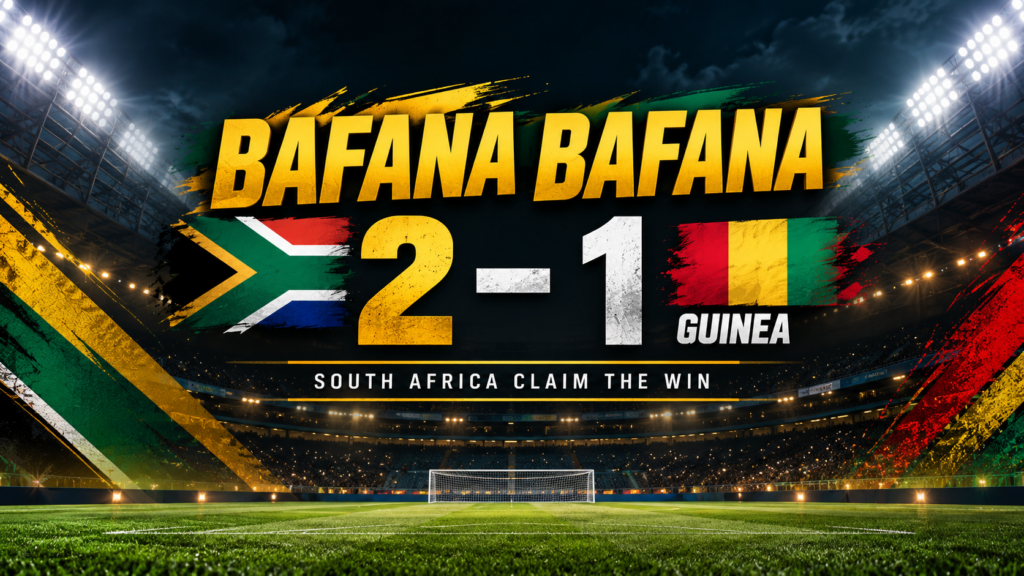
Ime Okon opened the scoring in the 30th minute, Guinea equalised through Sékou Cissé in the 69th, and Samukelo Kabini restored South Africa’s lead eight minutes later to seal a 2–1 win at Orlando Stadium.
At first glance, it looks like a fairly straightforward home win. It was not.
The underlying numbers tell us South Africa had more control than the scoreline suggests.
Bafana Bafana finished with:
- 56% possession
- 22 shots
- 5 shots on target
- 431 passes
- 5 corners
Guinea had:
- 44% possession
- 11 shots
- 2 shots on target
- 341 passes
- 4 corners
Bafana therefore produced twice Guinea’s shot volume while playing around 90 more passes.
Yet after 69 minutes, the game was 1–1.
That tension, between control and actual threat, might be the first important tactical lesson of the new Pitso era.
This is where Pitso’s Al Ahly gives us an important clue
One misconception about Mosimane’s football is that possession itself is the objective.
His Al Ahly teams suggest otherwise.
Under Pitso, Al Ahly were a high-volume passing side, but their passing was not intended merely to inflate possession percentages.
They used short combinations to progress through the thirds.
The full-backs pushed high.
Wide forwards moved inside.
Players rotated centrally to create numerical superiority.
And, importantly, the team produced a very high volume of progressive passes and penalty-area touches.
That distinction is critical.
The ball was supposed to take the opponent somewhere.
Possession was a mechanism.
Territory was the goal.
That should become one of the central questions we ask about this Bafana team.
Bafana therefore produced twice Guinea’s shot volume while completing around 90 more passes.
Yet after 69 minutes, the score was 1–1.
That tension between control and actual threat may be the first important tactical lesson of Mosimane’s new era.
Bafana had control. The question is what they did with it
Possession percentages are useful, but they are also one of football’s easiest statistics to overvalue.
Fifty-six percent tells us South Africa had more of the ball.
It does not tell us where they had it.
A team can accumulate possession between its centre-backs, full-backs and holding midfielders without seriously moving the opposition defence.
Another team can have exactly the same share of possession while spending long periods pinning its opponent into the final third.
The statistic looks identical.
The games are completely different.
That is why Bafana’s 22 shots add important context.
South Africa were not simply keeping the ball. They were getting into enough attacking situations to attempt twice as many shots as Guinea.
But another number complicates the picture.
Only five of those 22 attempts were on target.
That is just under 23%.
So while Bafana were generating volume, they were not consistently converting that volume into attempts that tested Guinea’s goalkeeper.
The first question of the Mosimane era may therefore not be whether South Africa can dominate possession.
The first game suggests they can.
The more important question is:
Can that possession consistently take Bafana into better shooting positions?
This is where Pitso’s Al Ahly gives us an important clue
One misconception about Mosimane’s football is that possession itself is the objective.
His Al Ahly teams suggest otherwise.
Under Mosimane, Al Ahly were a high-volume passing side, averaging around 500 passes per 90 in the Egyptian Premier League during the period analysed by Total Football Analysis. More importantly, they also led the league for progressive passes and penalty-area touches. Total Football Analysis
That distinction matters.
The ball was supposed to take the opponent somewhere.
Mosimane’s sides used short combinations to progress through the thirds. The full-backs pushed high. Wide attackers moved into narrower positions. The attacking midfielder searched for spaces between the lines. Those movements created additional passing options centrally and allowed players receiving deeper passes to face forward. Total Football Analysis
Possession was the mechanism.
Territory was the objective.
That gives us a better lens through which to view Bafana’s 56% possession against Guinea.
The useful question is not simply how much of the ball South Africa had.
It is:
Where did they have it?
If most of the 431 passes were circulation in front of Guinea’s defensive structure, the possession figure flatters Bafana.
If those passes repeatedly moved Guinea backwards, found players between the lines and established possession around the penalty area, then the same 56% tells a very different story.
And this is where the 57th minute becomes particularly interesting.
Minute 57: the first real coaching clue
Mosimane went to his bench before Bafana had lost their lead.
That detail matters.
South Africa were already seeing more of the ball.
They already had the greater shot volume.
The game had not collapsed.
So this was not an emergency substitution designed to rescue a broken tactical plan.
It was an attempt to improve a match Bafana were already controlling.
That is a different type of coaching intervention.
Managers often wait until the scoreboard forces their hand.
Mosimane did not.
He appears to have recognised that possession and attacking volume were not producing enough separation between the two teams.
The structure was functioning.
It simply needed something else.
A different runner.
A different relationship between positions.
A different type of movement.
More directness.
More energy.
More aggression attacking space.
That is why the substitution should not be judged simply because a substitute later scored.
The more interesting question is:
What problem was Mosimane trying to solve before the goal arrived?
[INSERT PLAYER BLOCK: Samukelo Kabini]
A substitute enters a different football match
There is a tendency to think of substitutions as simple replacements.
One player gets tired.
Another player comes on.
But the player entering after an hour is rarely entering the same tactical environment that existed at kickoff.
By the 60th minute, defensive distances have often become larger.
Midfielders cover ground more slowly.
Pressing becomes less coordinated.
Full-backs may take longer to recover.
The gaps between midfield and defence begin to grow.
Transitions become more frequent.
That changes the value of different player profiles.
A runner who struggles to find space against a fresh, compact defensive block in minute five can become extremely dangerous against the same defence in minute 70.
A winger who initially receives with two defenders around him may suddenly find himself isolated against one tired full-back.
A midfielder who struggled to receive between the lines may begin finding larger pockets as the opposition block stretches.
This is why the real analysis of Kabini’s impact should go beyond:
He came on and scored.
The better question is:
What became available to South Africa after the change that had not been available before it?
Then Guinea changed the problem completely
The irony is that Mosimane had already started changing the match before Guinea equalised.
Cissé’s goal in the 69th minute suddenly made all of Bafana’s statistical control irrelevant to the scoreboard.
South Africa could have had 60% possession.
They could have taken 30 shots.
The game was still level.
And this is often where a team’s attacking structure begins to unravel.
Players become impatient.
Shots arrive earlier.
Midfielders make runs beyond the ball.
Centre-backs begin forcing vertical passes.
The carefully constructed possession game becomes emotional.
Bafana had another challenge to solve:
Could they chase the winner without destroying the structure that had allowed them to control the game in the first place?
Eight minutes later, they had their answer.
Kabini scored.
The sequence is worth isolating:
57′ — Mosimane begins changing the game
69′ — Guinea equalise
77′ — Bafana retake the lead
That is considerably more revealing than simply recording a 2–1 result.
The winner may tell us something about Mosimane’s evolution
Mosimane’s strongest Sundowns teams established his reputation as a coach who wanted to dominate matches.
But his years at Al Ahly required something slightly different.
Continental football forces managers to solve different types of games.
One opponent presses aggressively.
Another sits in a low block.
An away knockout tie may require risk management rather than domination.
A one-goal lead may require a completely different approach from chasing a match at home.
Mosimane’s Al Ahly could build with high full-backs and narrow attackers, but they could also adjust their pressing and defensive behaviour according to the opponent. Their press was often less about constantly hunting the ball and more about removing nearby passing options and forcing opponents toward areas where pressure could be concentrated. Total Football Analysis
That adaptability may become one of the most valuable things he brings back to Bafana.
International football does not give coaches months of training sessions to perfect one system.
Sometimes there are only a handful of sessions before a qualifier.
The strongest national teams therefore need principles that can survive different formations, different opponents and different match states.
High full-backs, narrow attackers and the spaces between
There is another Mosimane principle worth watching as this Bafana side develops.
At Al Ahly, the full-backs frequently pushed high during possession.
That allowed the nominal wide forwards to move inside and occupy more central areas.
The result could be a front line stretching across five or six lanes, with the full-backs providing width and the attacking players occupying positions closer to goal. Total Football Analysis
That structure creates an interesting dilemma for the opposition.
If the full-back follows the winger inside, space opens outside.
If the full-back stays wide, the winger may receive between defenders.
If a midfielder drops to help, another central player may become free.
This is where formations become less useful than positions.
A graphic may still say 4-2-3-1.
But when possession settles in the opposition half, it can look completely different.
That is one of the patterns worth watching with Bafana over the next few matches.
Where are the full-backs receiving?
Where are the wide attackers receiving?
Who occupies the half-spaces?
Who receives between Guinea’s midfield and defensive lines?
Those details will tell us much more about Mosimane’s intentions than the formation listed before kickoff.
The 22 shots may be the biggest area for improvement
For all the positives, five shots on target from 22 attempts is the number worth interrogating.
More shooting does not automatically mean better attacking football.
A 25-metre shot under pressure counts exactly the same in the basic statistics as a one-on-one from eight metres.
Both are recorded as one shot.
Their probability of becoming a goal is obviously very different.
That means Bafana’s next attacking step is not necessarily to produce more than 22 attempts.
It is to create better attempts.
We would want to know:
How many came from inside the box?
How many were central?
How many followed a pass backwards from the byline?
How many followed a high turnover?
How many were headers under pressure?
How many came from outside the penalty area?
If Mosimane can keep the volume while steadily improving the location and quality of those attempts, the attacking numbers could become far more meaningful.
Progressive passing will tell us more than total passing
Bafana completed 431 passes.
That tells us something about control.
But total passes are still a blunt measure.
A five-metre pass between two centre-backs counts exactly the same as a line-breaking pass that eliminates four defenders.
This is where Mosimane’s previous teams give us another useful benchmark.
His Al Ahly were not only a high-volume passing side; they were extremely active in playing progressive passes and moving the ball through the opposition’s structure. Total Football Analysis
That is the progression worth watching with Bafana.
How many passes break a defensive line?
How frequently do midfielders receive facing forward?
How often does the number 10 receive between midfield and defence?
How frequently does possession enter the final third?
Those are better measures of whether the team’s passing actually hurts opponents.
There is also a risk in committing numbers forward
Every attacking system creates vulnerabilities.
Mosimane’s use of aggressive full-backs and players between the lines can create numerical advantages around the opposition box.
But it can also leave space behind the attack if possession is lost.
That weakness was visible at times during his Al Ahly tenure: when progressive passes failed against compact defensive blocks, opponents could counter into the spaces left by players committed ahead of the ball. Total Football Analysis
That will be something stronger international opponents look to exploit.
If Bafana commit both full-backs high and lose possession centrally, who protects the transition?
How quickly can the midfield close the first forward pass?
How comfortable are the centre-backs defending large spaces?
Those questions may not decide matches against every opponent.
Against elite opposition, they probably will.
This is not a rebuilding job
Mosimane has also inherited something valuable.
He has not taken over a national team requiring a complete reset.
His first squad retained much of the existing core while introducing five uncapped players — Lebone Seema, Brooklyn Poggenpoel, Yanela Mbuthuma, Puso Dithejane and Tashreeq Matthews. Confédération Africaine de Football
That balance makes sense.
There is already tournament experience in the squad.
There are established relationships.
There is a base from which to work.
Mosimane therefore has the luxury of adding ideas rather than spending his first camps establishing basic credibility.
That may explain why the first interesting coaching signal came from an in-game adjustment rather than an entirely new starting structure.
Evolution rather than revolution.
The bench could become part of Bafana’s tactical identity
International tournaments are rarely won by only 11 players.
Depth matters.
But depth becomes truly valuable when a manager understands why one profile is more useful than another at a particular point in a match.
The starting XI establishes one set of problems for an opponent.
The bench should create another.
More pace.
More width.
More physicality.
Another player between the lines.
A runner beyond the striker.
A midfielder capable of controlling a lead.
A pressing forward when the opponent begins tiring.
Kabini’s contribution against Guinea is therefore interesting beyond the goal.
If Mosimane can repeatedly identify which type of player a match needs after 50, 60 or 70 minutes, Bafana’s depth becomes something more than injury insurance.
It becomes part of the tactical plan.
What did we actually learn from game one?
One match is nowhere near enough to define Mosimane’s second Bafana era.
But there are early signals worth tracking.
Bafana are comfortable taking responsibility for the ball
The possession and passing numbers suggest South Africa are willing to construct attacks rather than waiting for opponents to make mistakes.
Control needs to become cleaner chance creation
Twenty-two shots is excellent attacking volume.
Five on target suggests the relationship between possession, shot selection and chance quality can still improve.
Mosimane will intervene before the scoreboard forces him to
The 57th-minute change came while South Africa were still leading.
That is one of the most interesting details of the match.
Bafana responded to adversity without losing the game
Guinea equalised after 69 minutes.
South Africa restored the lead eight minutes later.
That response deserves attention.
The bench could become a major tactical weapon
Kabini’s contribution offered an immediate example of how different player profiles can change a match after the starting plan has done its work.
Three points — and a useful first data point
Mosimane’s first task was to win.
He did.
South Africa now have the result they needed and an opening three points in the AFCON qualifying campaign.
[INSERT TABLE BLOCK: AFCON QUALIFYING GROUP D]
But the long-term importance of the Guinea game will depend less on the points themselves and more on whether the patterns we saw become repeatable.
Can Bafana establish possession higher up the pitch?
Can 22 shots become 22 better shots?
Can the full-backs and attackers create consistent overloads?
Can the midfield protect the team when possession is lost?
Can Mosimane continue using his bench to change the tactical problem facing the opposition?
Those are the questions that will tell us where this team is really heading.
The scoreboard gives us the simplest version of the story:
South Africa 2–1 Guinea.
The numbers give us another:
56% possession. 22 shots. 431 passes.
But the most interesting story sits somewhere between them.
Bafana controlled the match.
The match still became uncomfortable.
Mosimane changed it.
And his team found another solution.
For a coach beginning his second spell with the national team 14 years after the first one ended, that may be the most encouraging sign of all.
The result matters. The mechanism matters more.
 Duduza